My Favorite AI Tool Stack
Why I moved from Claude Code to Pi and BB for local agentic development, and how I combine frontier models, open harnesses, and extensions.
Contents
The model is only half the story
Models from the frontier labs are progressing faster and faster. We got Opus 5.5 and GPT-6-Astra, and now we have Gemini 4 Argon. However, it is not just the engine (the model, the CPU) that matters. That is just half of the story.
The other half is the IT stack built to support the customer experience. In the case of the web experience (ChatGPT, Claude), this is, for example, integrated image generation, web search, research capabilities, collecting threads into projects, or spinning up workflows on cloud-based sandboxes.
In the case of local agentic development, we could call it the Harness—that agentic application running the tasks with the help of the model. The model gets access to certain tools in a harness (files, bash, MCPs) and certain context (skills, AGENTS.md, etc.). These are all very important building blocks.
As with the models, the tools are also on an exponential development scale.
From Claude Code to Pi: taking back control of tokens and context
Initially, my favorite agentic application was Claude Code (the leading CLI-based agent). Like others, I also experienced that vendor-shipped agents are not necessarily spending tokens in the most effective way. Also, the different providers offer an experience that changes. For example, OpenAI was generous, and now Claude is better with Opus 5.5. This is changing as the frontier labs are sometimes giving more or less to personal subscription users.
This basically started me trying out the Pi Agent. The benefit of this is they created a minimalistic, “build your Agent for yourself” approach where the context (what is included in the session) is transparent.
Pi, for example, is not supporting sub-agents out of the box—and in the same way, it is good that you are in control of when to switch sessions or not. Those sub-agents, for example, can spend a lot of tokens on research tasks, and when you hand off control, you might pay with your money or limits.
Why pure CLI isn’t enough: moving to BB
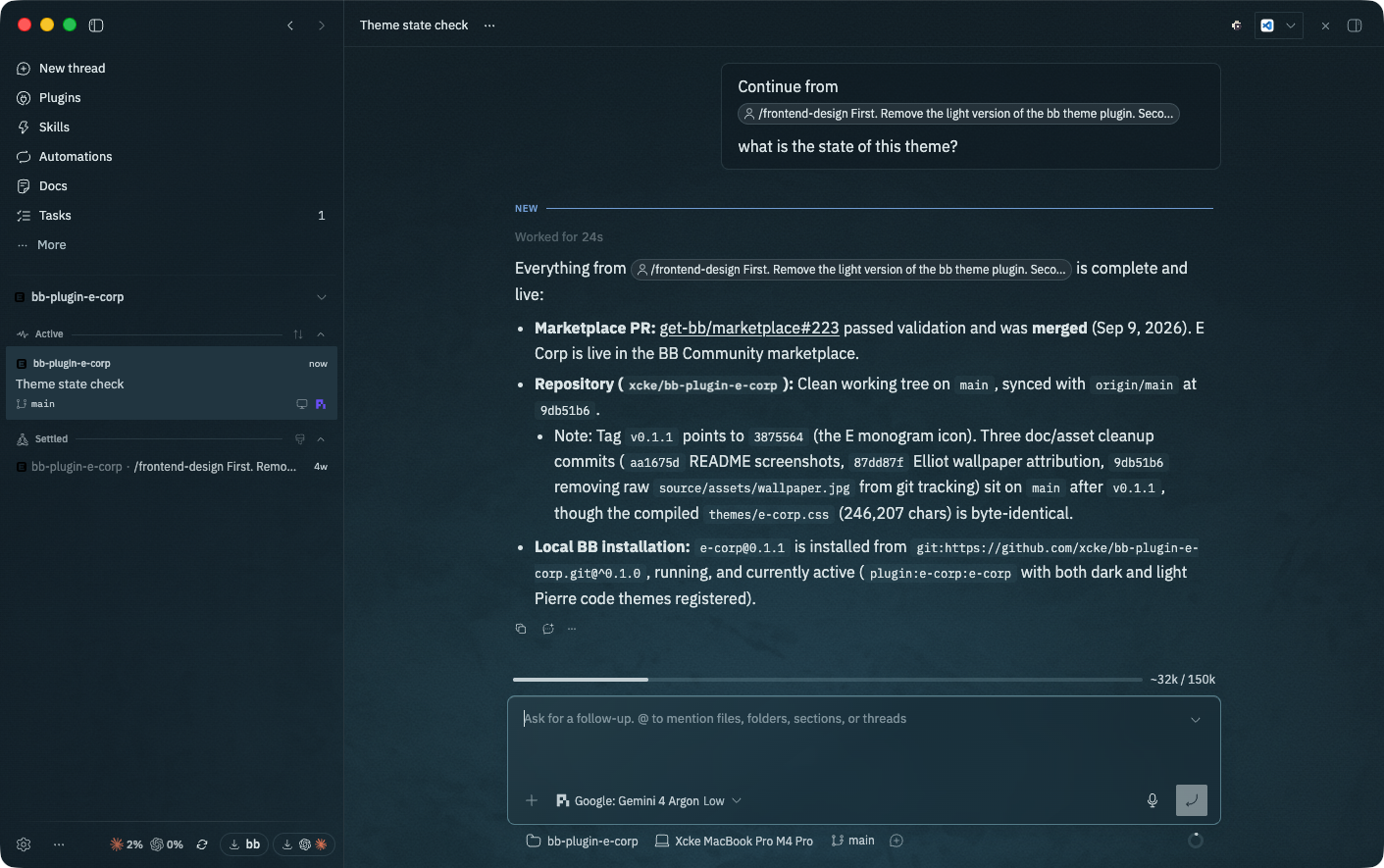
After I used Pi, I started to look for a better UI/UX. You know, I like the CLI, but reading a lot of text (and managing multiple projects) is just not providing a good UX in the CLI.
After this, I found the BB project, which has a very similar principle to Pi: build and extend as you want. BB offers a lot of good features and supports all kinds of providers (Codex, Claude Code, Grok, Gemini, etc.).
The good part of BB is you can use the right “Harness” for the right task. For example, Codex supports image generation, so you can delegate a task to Codex, or you might leverage Claude Code for the Team features, but 98% of the work you run inside Pi.
These are my favorite BB features:
- Nice UI to read the agent-generated text.
- Mobile experience: works very well and makes it easy to connect from mobile to your session.
- Extensibility and fast acceptance to the plugin marketplace (I tested this with my theme).
- Git integration across the whole interface.
- Built-in browser and CLI: a common pattern so you don’t have to leave the window for testing, etc.
- Good set of BB-shipped extensions: Docs, Automations, Tasks, Inline Visualizations, Side Chat, Custom Instructions, and Ask User Question.
And these are my favorite community BB extensions:
- Usage Tracker from Mateo: shows the leftover tokens from my subscriptions (Claude Pro and ChatGPT Plus) for the 5h and 7d windows.
- Context Meter: shows the “smart zone” of models—e.g., helps to stay inside 150k tokens as per Matt Pocock’s recommendation.
- Calm: nice visual effects when the Agent is working.
- E-Corp: a Mr. Robot-inspired theme I created.
How I run my subscriptions and models
I usually use the latest frontier models (Opus 5.5, GPT-6-Astra, Gemini 4 Argon), and for trivial tasks I fall back to Sonnet 5.5 and GPT 6.1 Sol. I use two subscriptions: the Claude web stack is utilized by me, and my wife uses the ChatGPT stack—however, we can share the ChatGPT account for agentic development. I believe it only makes sense to use tokens via a subscription, and it is good if you have multiple so you are able to test the recent developments.
Frontier labs and their offerings are changing rapidly, including the subscription limits, model quality, and personality. Locking yourself into one vendor’s CLI (or UI) is a trap—using an open harness (BB + Pi) lets you swap models and subscriptions without changing how you work. It is also advantageous that you can freely extend your harness (Pi) and orchestrator (BB) as you wish.